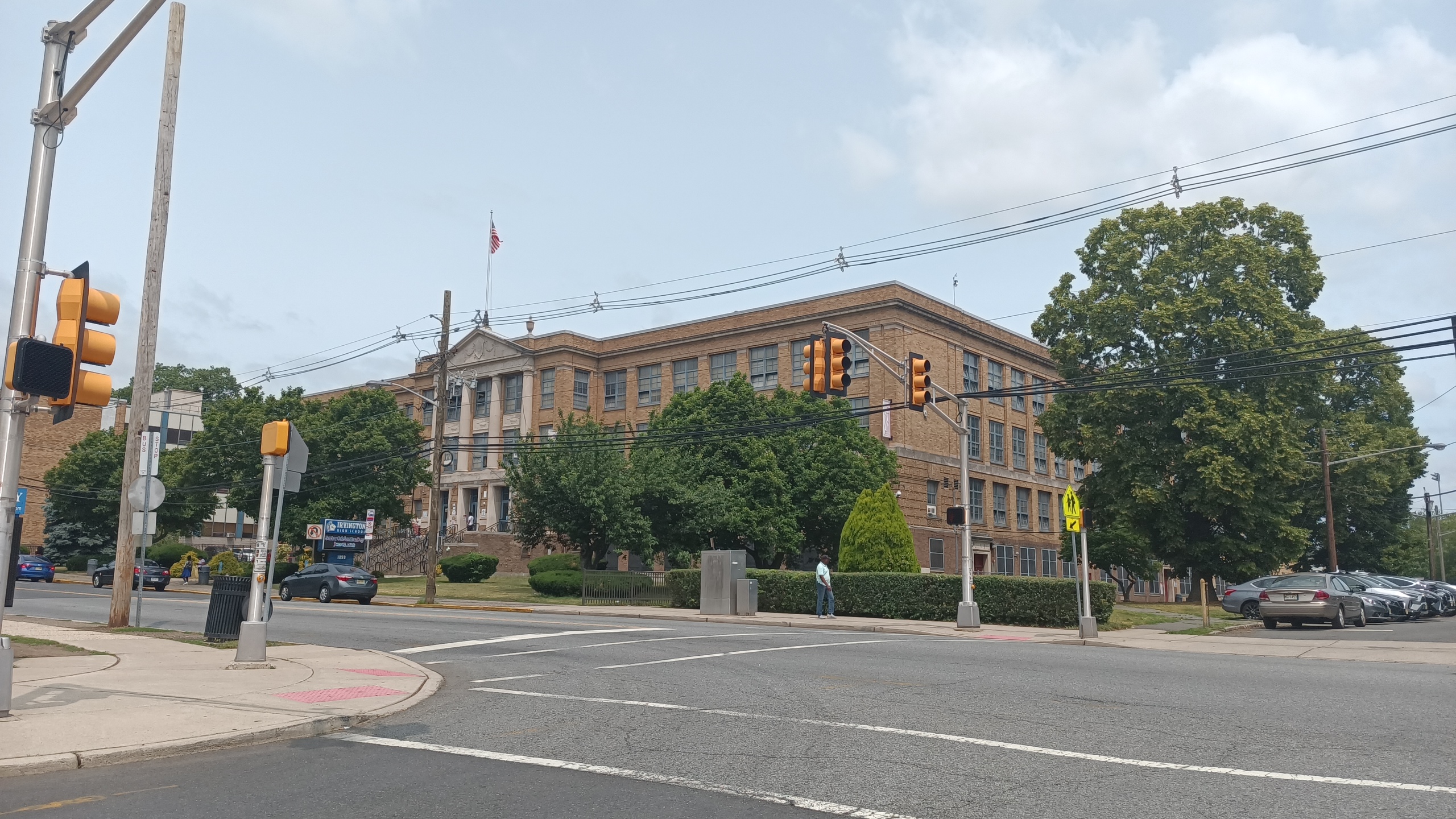
Irvington High School
BY WALTER ELLIOTT
ESSEX – There is more than the usual anxiety among Local Talk area public school administrators and numbers crunchers throughout the County who face public hearings and final passage of their proposed 2026-27 school budgets.
A revised funding formula for state education aid, to be formalized in the 2026-27 State Budget before June 30, has resulted in nine districts getting more aid this upcoming year – and two who are getting less than last year.
Gov. Mikie Sherrill (D-Montclair) has increased statewide school budget aid by $2.4 billion for 2026-27. This year’s distribution among the 547 public districts (including county vocational technical schools but never charter schools) is covered by annual State Legislature adjustments to the 2008 School Funding Reform Act.
Even those who got increased state aid say that it is not enough to offset inflation – particularly in health insurance plans.
Herewith is a snapshot of the public school district proposed budgets and the challenges they face as they enter their late April public hearings and final votes:
NEWARK PUBLIC SCHOOLS: $1.677 billion, including $60.6 million state aid increase. School property tax increased two percent to $146,780,923.
NPS’ budget, which the Board of Education had approved on March 27, is for the state’s single largest public school district by student enrollment, employee payroll, number of facilities and in proportion of state aid.
Newark’s budget, to operate one of 32 statewide “neediest” districts, is predominantly made up from state aid. Irvington, East Orange and Orange’s districts also fall into that category as addressed by some 15 “Abbott vs. Burke” New Jersey Supreme Court rulings for a “thorough and efficient education” going back to 1974.
Municipal property tax payers, however, are asked to pay a contribution share of $146,780,923 – which is a two percent increase from $143,902,866 in the current 2025-26 school year.
The increased state aid and property tax reflects higher costs found with health benefits insurance and tuition paid out to charter and out-of-district schools.
IRVINGTON PUBLIC SCHOOLS: $79,717,771.98 including six percent state aid increase to $190,014,533 and a flat $17,459529 property tax levy.
The IPS Board of Education may take a final vote on its proposed $79.717 million budget as early as its April 15 meeting or if needed, a special meeting between then and its annual May 20 reorganization meeting. That Wednesday night agenda was not posted as of press time.
EAST ORANGE SCHOOL DISTRICT: $234.7 million, including a 5.3 percent state increase to $9.3 million and a flat property tax rate.
The proposed budget, introduced on March 25, included the coverage of $16.3 million in cost increases. The balancing was made in part by using $1.3 million in special revenue, transferring $1 million of state aid into the general revenue fund, the elimination of 11 administrative positions and considering the outsourcing of custodial services.
This budget was made in the wake of a wintertime lay off or reassignment of 93 EOSD employees to plug a $25 million hole found in the current budget around Labor Day.
ORANGE PUBLIC SCHOOLS: $204,410,276, including a 2.25 percent state increase to $136,594,539 and a flat property tax.
OPS’s preliminary budget, as introduced March 24, dials in the extra $3,00,082 from Trenton.
WEST ORANGE PUBLIC SCHOOLS: “In flux” with an up to a $15 million deficit, a six percent state increase to $34.5 million and a proposed 2.5 property tax increase.
WOPS is looking to balance its 2026-27 budget by laying off at least 70 full-time employees, increasing classroom sizes, consolidating some courses and restructuring the middle schools class schedules. Health insurance benefit increases have gone up to 17 percent.
SOUTH ORANGE-MAPLEWOOD PUBLIC SCHOOLS: $200 million including a six percent state aid increase to $11,595,011 and a 5.63 percent property tax increase.
The two-town district was faced with an $8.7 million budget gap when introduced on March 25. Schools Superintendent Jason Bing and his administrators identified $6 million in economies including a shift to health benefits self-insurance, the elimination of 23 employees through attrition and layoffs and the elimination of courtesy busing. Tighter vendor contracts and cuts to “pay to play” sports are being considered.
BLOOMFIELD PUBLIC SCHOOLS: $152.57 million including a three percent – or $1.5 million state aid reduction and a 4.97 percent property tax increase.
The budget is being balanced in part by salary freezes for administrators and unaffiliated staff members, reductions in discretionary spending for supplies, supplemental programs and technology.
“We’re in the midst of a statewide school funding crisis,” said Bloomfield Board of Education President Kasey Dudley. “One that’s rooted in the lack of overall funding and in how funding is distributed and how local capability and capacity is calculated.”
MONTCLAIR PUBLIC SCHOOLS: $158.9 million budget including an $8.8 million 2025-26 budget deficit, a six percent state aid increase to $10.47 million, and a 3.92 percent property tax increase.
This 26-27 budget was being drafted while it dealt with $19.7 million in deficits from the current and 2024-25 school year budgets. A majority of township voters had narrowly approved a one-time property tax increase to plug the $12.6 million 24-25 gap March 10 but more narrowly defeated what would have been a recurring $7 million tax increase.
The question became not whether but by how much would there be economic pain. That includes the elimination of 32 jobs, the restructuring of the Rand at Renaissance Middle School to a central Pre-Kindergarten center (with the middle schoolers parted out to Glendale and Buzz Aldrin MS) and reducing transportation services. There will be a concurrent $500,000 forensic budget audit.
GLEN RIDGE PUBLIC SCHOOLS: $44.2 million including a 2.78 percent state aid increase to $2,607,000 and a 2.7 percent property tax increase.
The GRPS Board of Education is allowing the administration to withdraw $1,632,505 from its capital reserve to replace the 1968-era Glen Ridge High School roof. A public hearing and final vote are set for April 28.
BELLEVILLE PUBLIC SCHOOLS: $139,110,586 with a 1.51 percent state aid decrease to $67,268,777 and between 4.57 and 10.07 property tax increase.
First-year Schools Superintendent Dr. Erick Alfonso said that BPS is suffering a $2 million deficit largely due to state and federal aid (down 20 percent) cuts. That gap is to be in part filled by calculating its health care benefits and withdrawing $1 million from capital reserve to pay for the likes of new windows for the 1964-ear Belleville High School and a new boiler for School 8.
NUTLEY PUBLIC SCHOOLS: $95.026 million including a six percent state aid increase to $12,840,191 and a two percent property tax increase.
NPS is filling a $2 million gap through losing several positions through attrition and restructuring its John Walker Middle School for now-sixth through Eighth grades. The board, in concert with the Township Commissioners, have renovated a Bloomfield Avenue office building into a Pre-K school.
This is the district’s first complete budget process with state monitor observation. The monitor, who has financial and budgetary veto power, was brought in by the N.J Department of Education in exchange for the agency lending the district $7 million to plug a 2024-25 budget deficit.