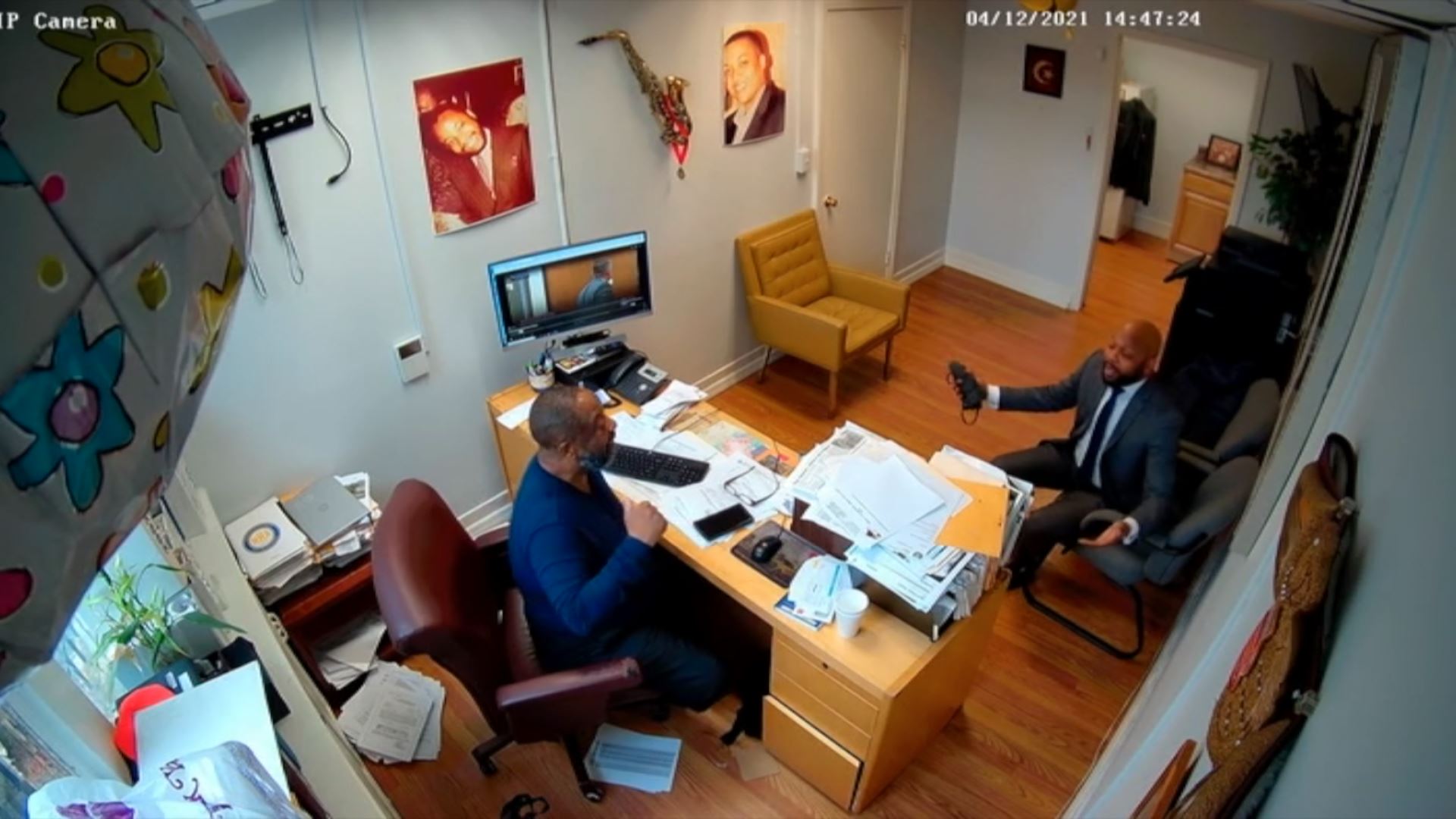
A screengrab of Alif Muhammad’s video.
BY LEV D. ZILBERMINTS
NEWARK – Former Newark Housing Authority Commissioner Alif Muhammad has gone public with allegations of corruption, intimidation, violation of state and federal laws, attempted illegal removal from an appointed position and more.
The whole dirty affair has been captured on video. Mr. Muhammad turned over the flash drive with this video to state, federal authorities and the press.
As of this writing, the video, dated April 12 and 13, 2021 is making rounds on social media.
The parties who are alleged to be complicit in corruption are Newark Mayor Ras Baraka; his brother and Chief of Staff, Amiri Baraka, Jr.; Eddie Osborne, Newark Housing Authority (NHA) Board of Commissioners Chairman until January 2022, Municipal Council member until June 2022; Norma Gonzalez, NHA Board Member, NHA Chairperson, 2022 – April 2024; Brian Logan, NHA Board member; Newark Central Ward Councilwoman LaMonica McIver, elected 2018, since Sept. 23, 2024 Congresswoman; Victor Cirilo, Executive Director, NHA 2018-2024, terminated; Elio Mena, General Counsel NHA, retired.
The current members of the Newark Housing Authority Board of Commissioners are Brian K. Logan, Chair; Imam Daud-Haqq, Vice Chair; Vivian E. Carter, Commissioner; Patrick Council, Commissioner; Asraf Latif, Commissioner; Linda Washington, Commissioner; Christopher Watson, Commissioner.
According to a statement distributed by Mr. Muhammad to the audience, Newark City Council members and the press at the March 18, 2026 City Council meeting, the whole mess started back in April 2021. At that point in time Alif Muhammad was Vice President of the Newark Housing Authority Board of Commissioners since January 2021.
The cause of the scandal was Resolution H-21-08-04-02, offered by Muhammad to bring the landscape contract back in-house for service by eleven new Newark employees at the 25+ sites to service Newark Housing Authority. This occurred, per documents given out by Mr. Muhammad, on April 8, 2021. At that time, the resolution passed.
Question is, what is so out of ordinary in the passage of a resolution? Apparently, judging by the reaction, Newark Mayor Ras Baraka and his allies had other plans.
Alif Muhammad’s account of being pressured to change his vote
According to Alif Muhammad’s account, “Ten minutes after the meeting, I received phone calls and texts (that I refused) from Newark’s Chief of Staff Amiri Baraka, Jr. Also, I received phone calls from Chairman Eddie Osborne, NHA, Brian Logan, Board Member, then – Central Ward Councilwoman LaMonica McIver, all advising me that Amiri Baraka, Jr. is demanding that I change my vote for the above resolution H-21-08-04-02.”
According to New Jersey Monitor.com of May 15, 2025 the former commissioner refused to change his vote on the resolution. “I don’t want to do it,” Muhammad alleged he told Baraka. “All I have is my integrity.”
“Integrity is about us,” he said Baraka told him. “This is politics and this is the world you’re in. When someone else disrespects me it’s going to be a problem.”
New Jersey Monitor.com also reported that, “Muhammad also claims Amiri Baraka told him, ‘At the end of the day I protect my brother,’ ‘that’s all I do,’ and that Amiri Baraka griped that pay-to-play laws made it so that we can’t make no money in this town.”
What the law says
Research done by Local Talk shows that in New Jersey, a housing authority is a “body corporate and politic” that functions as an independent agency of the municipality. While a mayor or governing body often has the power to appoint commissioners, their ability to influence a commissioner’s specific vote is legally restricted by the following principles:
- Independent agency status: Housing authorities are separate legal entities from the municipal government. Commissioners are expected to act in the best interest of the authority and its residents, not the mayor.
- Removal for cause only: Under the Local Redevelopment and Housing Law (N.J.S.A. 40A – 12A-1 et sequence) a commissioner can typically be removed for specific reasons such as inefficiency, neglect of duty or misconduct in office. A mayor cannot legally remove a commissioner simply for voting against the mayor’s preferences. If a mayor were to pressure a commissioner by threatening removal, it could be challenged as an unlawful use of executive power.
- Ethics and conflicts of interest: New Jersey law prohibits commissioners from having a direct or indirect interest in any housing project on contract related to the authority. If a mayor asks a commissioner to vote a certain way to benefit a specific interest, it could lead to violation of state ethics laws or lead to corruption investigations.
- Administrative oversight: The New Jersey Department of Community Affairs (DCA) provides oversight for housing authorities. If there are concerns about “undue influence” being exerted over a board member’s vote, the presiding officer or the DCA may investigate on the basis of these actions.”
Mayor pressures Commissioner to reverse vote
According to a written account by Alif Muhammad and video saved on flash drive, “April 12th and 13th, 2021 I received an unannounced visit at my office from Amiri Baraka Jr. demanding that I change the vote for the above resolution (H-21-08-08-02). I refused, and at that point, the Chief of Staff violated several federal and New Jersey statutes. On April 14th, there was a special meeting on a new resolution. It was passed, providing landscaping for NHA property. At that time, I advised the Board of Commissioners that I filed a complaint to the office of Investigation General – HUD- NJ Division.
Also on April 14, 2021 a letter was sent to the City of Newark Municipal Council to remove me as Commissioner.”
Legal Analyses
As was noted earlier in this article, pressuring a commissioner to change his vote is illegal under state and federal law. Removing a commissioner for voting against the mayor’s preferences is also illegal under state and federal laws. Among other things, it violates civil rights, right to due process; the First Amendment; and a slew of other state and federal laws, rules and regulations.
Forcing a public housing authority (PHA) commission member to change their vote through threats, coercion or intimidation constitutes a serious crime, punishable under both federal and state laws. Potential penalties include significant fines and imprisonment, with terms ranging from one year for voter coercion to up to 20 years for extortion or public corruption depending on the jurisdiction and method of force.
Removal of commissioners
A commissioner can only be removed after they have been given a copy of the charges against them at least 10 days prior to a hearing and have had the opportunity to be heard in person or by counsel.
Generally, members serve at the pleasure of the appointing authority, usually the mayor or council, though their terms are typically for 5 years.
What New Jersey Recording Law says
According to legal research, New Jersey is a “one-party consent” state for recording, meaning that it is legal to record in-person or phone conversations if you are a participant or have one participant’s permission. It is a third-degree crime to record conversations you are not involved in, or to record for criminal purposes.
Federal law
Federal intervention can happen. In extreme cases of default, the U.S. Department of Housing and Urban Development can take over a local housing authority as was set for the Atlantic City Housing Authority in 2025.
Federal law provides stiff penalties for intimidation or coercion of a public official. Federal law 18 U.S.C. Section 594 prohibits intimidation or coercing a public official in the exercise of their duties, including voting, which is punishable by fines and up to one year in prison.
Local Talk wrote in its May 24, 2024 article that NJ Revised Statutes title 40A: 12A – 17 were the relevant state law here.
Research on the Internet shows that “Federal charges for quid pro quo – meaning “this for that” exchange – typically involve bribery, extortion or honest services fraud when a public official corruptly exchanges official acts for something of value. Key statutes include 18 U.S.C. Section 201 (bribery of officials), 18 U.S.C. Section 1951 (Hobbs Act extortion) and 18 U.S.C. Section 1346 (honest service fraud). Penalties are severe, including up to 15-20 years in prison, heavy fines, and disqualification from holding office.
Restrictions on Accepting Gifts
Sections 3 and 23 of the Newark Housing Authority Handbook give restrictions on accepting gifts.
“It is illegal to request or accept anything of “substantial value” – in other words, anything with a value of over $50 or more – from anyone. If you receive it “for or because of ” a specific official act or an act within your official responsibility then you have performed or will perform as a housing authority member or employee. It is also illegal for a private party to offer or give anything of substantial value to you because of such acts that you performed or will perform. This is true even if there is no corrupt intent on the part of either the giver or receiver.
You also may not request or accept a gift of substantial value from anyone if you are receiving it because of the official position you hold as a housing authority or employee, even if the motivation for the gift is to express gratitude for a job well done or to foster goodwill.”
What could happen?
The resulting controversy around the video may well lead to the unseating of certain Municipal Council members. Since Alif Muhammad filed a lawsuit in federal court, this means federal and state authorities will begin investigation. The video is very solid evidence in a court of law. At a minimum, the video may undermine incumbent Mayor Ras Baraka’s chances for reelection to a fourth term.
The effect on Baraka – allied members of Newark Housing Authority members is less clear. Since commissioners are appointed, they would have to be investigated either by state or federal authorities.
As for Congresswoman LaMonica McIver, the most that could happen is a strong rival challenging her for reelection. How that will fly is anyone’s guess.
Local Talk will keep its readers updated on the latest developments in this story.
Meanwhile, Local Talk contacted Mayor Baraka’s office regarding the allegations. We were told that a response should come next week. We have also invited the mayor as well as other official mayoral candidates for an interview pertaining to the upcoming election.