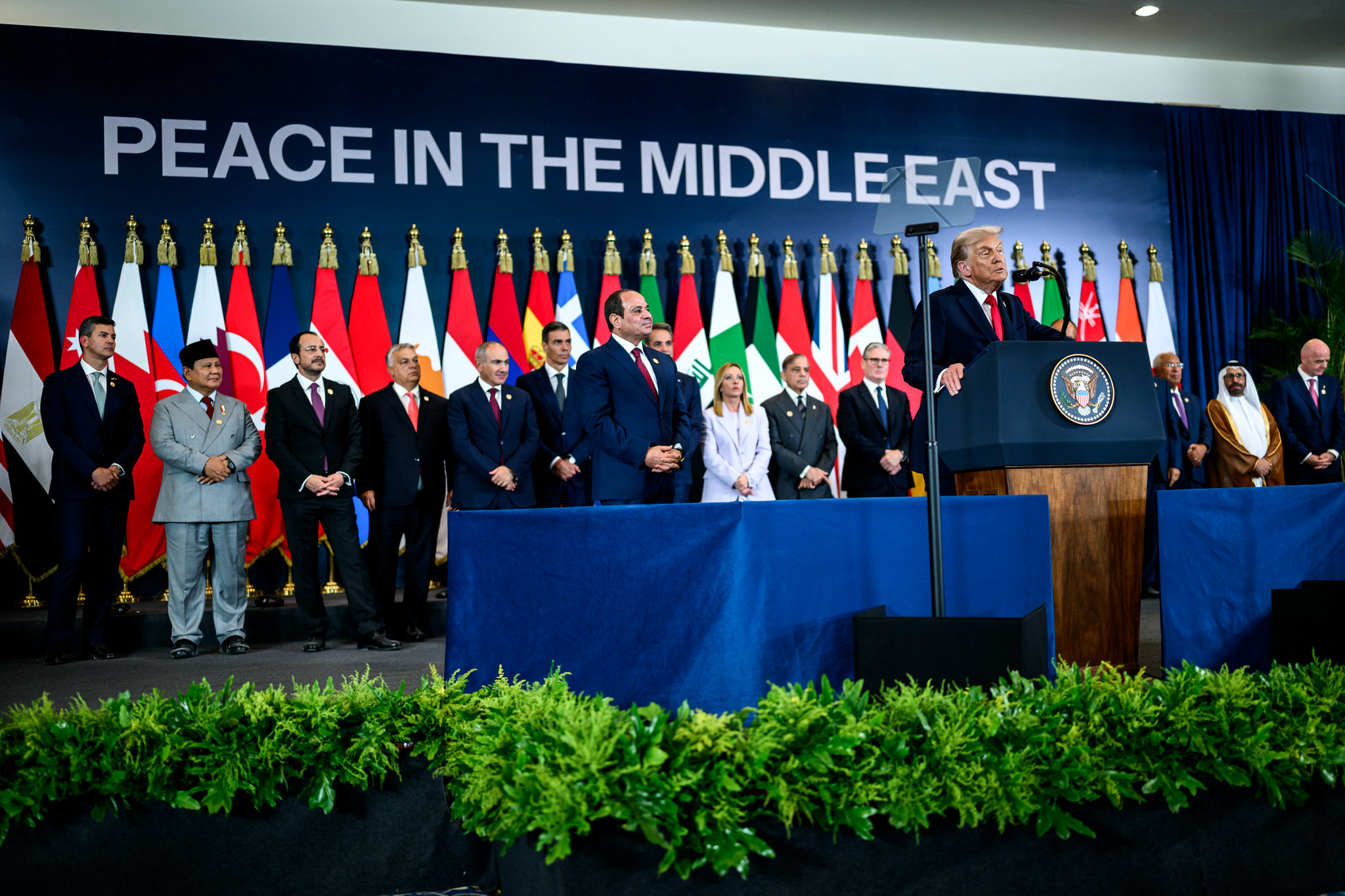
A summit of world leaders on ending the war between Israel and Hamas. Official White House Photo by Daniel Torok
No one knows for certain if it will hold, but as of now, a war that has raged for just over two years has finally come to an end – or at the very least a pause.
Last week, U.S. President Donald Trump announced that a deal was reached for Hamas to release its living hostages and to turn over the bodies of the deceased. In exchange, Israel would release dozens of people on the other side. Most of all, both sides would not fire upon each other.
Per the UN, as the UN Secretary-General welcomed the release of all living hostages from Gaza, aid agencies said that lifesaving relief supplies are now flowing at scale into the shattered enclave.
António Guterres expressed his “profound relief” that the hostages had been freed, two years since they were among some 250 taken during Hamas-led terror attacks in Israel on October 7, 2023, before highlighting their “immense suffering.”
The UN Secretary-General’s comments came as he headed to Egypt’s Sharm el-Sheikh along with world leaders for the Gaza peace summit. The international gathering was convened after Israeli forces pulled back from parts of Gaza, in line with an agreement between Israel and Hamas, brokered in Egypt by US mediators and representatives from Qatar and Turkïye.
In a message on X, Mr. Guterres reiterated his call for the release of the bodies of the deceased hostages and urged “all parties to build on this momentum and to honor their commitments under the ceasefire to end the nightmare in Gaza.”
Meanwhile, UN aid agencies reported significant positive developments in getting aid into Gaza.
“Our humanitarian scale-up in Gaza is well underway,” said UN humanitarian agency OCHA, which noted that it had secured Israeli approval for 190,000 tons of food, shelter items, medicine and other supplies to enter the Strip, 20,000 more than previously agreed.
In addition, “more tents for displaced families, frozen meat, fresh fruit, flour and medicines also crossed into Gaza throughout the day on Sunday,” OCHA said in any update.
Crucially, the aid agency reported that its workers and partners were now able to move more easily “in multiple areas” – a welcome development after constant access restrictions imposed by the Israeli authorities.
This has allowed aid teams to pre-position medical and emergency supplies “to where they are needed most,” the UN agency said, in addition to assessing key roads for explosive hazards and supporting displaced families in flood-prone areas ahead of winter.
“This is just the beginning. As part of our plan for the first 60 days of the ceasefire, the UN and our partners will expand the scale and scope of our operations to deliver life-saving aid and services to virtually everyone across Gaza,” OCHA continued.
Two years of extreme violence and constant Israeli bombardment have left many families without homes to return to.
The violence has also created vast physical and psychological needs across Gaza which UN agencies are already addressing.
UNICEF, the UN Children’s Fund, underscored that “all one million” youngsters in the Gaza Strip need mental health and psychosocial support.
The war has devastated youngsters’ sense of safety, their development and wellbeing, the UN agency insisted, with many displaying “severe stress symptoms” such as withdrawal, nightmares and bedwetting.
To help children heal and overcome their fears, UNICEF supports a self-help recovery program in which trainers show children how to employ stress-management techniques to release and process painful thoughts and images.
One device is an imaginary “safety button” that children can press when they feel overwhelmed by their situation.
“Whenever I felt scared, I would put my hand on the safety button and take a deep breath in and out. It made me feel so relieved,” said Anas, 15, one of the children helped by the scheme.
In 2025, UNICEF said that eight in 10 of the youngsters participating in the program showed reduced symptoms of traumatic stress.
UPDATE: Israel announced late on Oct. 14 that it will limit the flow of aid to Gaza, accusing Hamas of breaching the ceasefire agreement by returning only four of the bodies of deceased hostages so far.
The Israeli military body which coordinates with the UN and other international organizations, COGAT, said in a statement that starting Wednesday, it will allow only 300 of the previously agreed 600 aid trucks from the UN and other NGOs to enter the Gaza Strip, ending the flow of commercial goods.
COGAT added that no fuel or gas supplies will be allowed into the enclave, except where it relates to humanitarian needs.
In a press briefing, Olga Cherevko, Spokesperson in Gaza for the UN aid coordination office, OCHA, said the agency would continue to encourage the two sides to adhere to the agreements set out in the ceasefire deal.
“We certainly very much hope that the bodies of the hostages are handed over and that the ceasefire continues to be implemented,” she said.