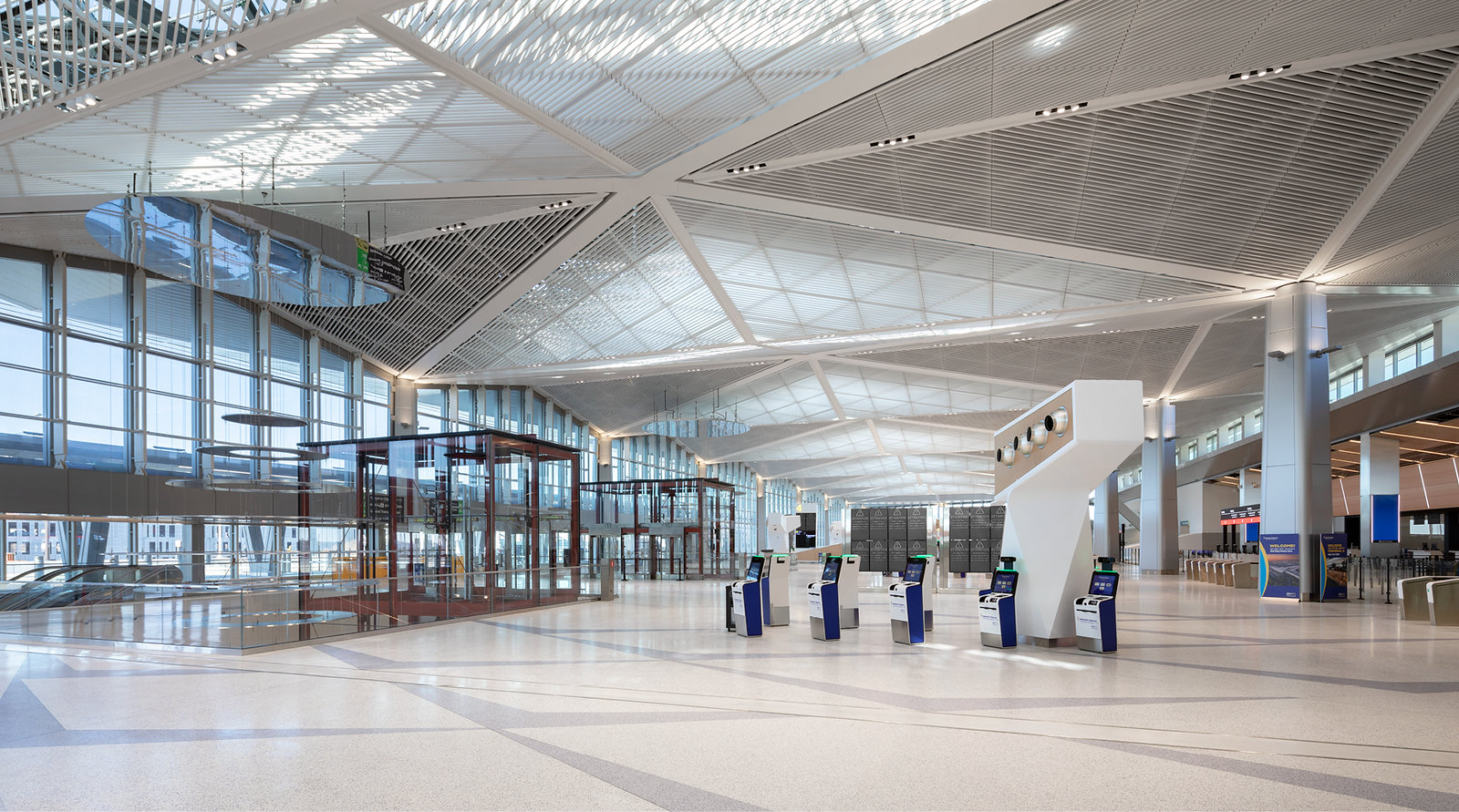
Terminal A at Newark Airport
BY WALTER ELLIOTT
NEWARK – There are those in and around Newark Liberty International Airport, given the events between Feb. 14 and March 23, are beginning to wonder when things will ever return to normal.
Some familiar faces – namely U.S. Transportation Security Administration agents at passenger check-in – have disappeared along with their paychecks since Valentine’s Day.
Some of the TSA agents who have gone on sick leave or quit have been temporarily replaced, or remaining agents supplemented, by new faces. Members of Immigration and Customs Enforcement, who are not wearing masks, have been here at EWR and 13 other airports since 6 a.m. March 23.
EWR air traffic controllers were responding to its Port Authority of New York and New Jersey sister LaGuardia Airport’s late March 22-midday March 23 ground stop when they had to call a 35-minute Monday stop of their own due to a smoke condition.
Newark’s controllers ordered a 7:30 a.m. Monday ground stop while they evacuated their 1973-built tower cab, said the FAA, “by a burning smell coming from an elevator.”
A ground stop means that no arrivals or departures would be made from or to an airport due to a natural or human emergency. Departures were held at their gates or canceled and would-be arrivals diverted to a nearby airport. EWR last called a ground stop – due to heavy passenger volume – on March 20.
Evacuated controllers regrouped at a backup tower in Terminal C and the stop was lifted by 8 a.m. – still in the middle of Monday morning rush hour. What spillback, in the form of delayed flights affecting later arrivals and departures, was not disclosed as of press time. The 30 minute suspension, “Local Talk” calculates, affected 14 to 18 flights, based on the current 28-36 flights per rush hour under current FAA restriction.
Nor is it known how many arrivals bound for LaGuardia had been diverted to here or other airports when “LAG” went on their own ground stop between 11:37 p.m. Sunday to 2 p.m. Monday. That suspension affected an estimated 200 flights there.
That stop was precipitated when an Air Canada Express flight from Montreal that had just landed on Runway 4 collided with a PA fire truck at that time. The collision destroyed the airliner’s nose and overturned the truck – which was responding to a smoke condition of another airplane that was preparing for take off.
The Air Canada Express pilot and co-pilot, from the Montreal area, were killed. At least 37 of the two remaining crew members and 72 passengers plus two firefighters required hospitalization.
Although EWR and LAG are operated on a lease by the PA, LaGuardia, at 630 acres, is the smallest of the three major metro NYC airports. Newark, at 2,707 acres, is spacious. The size and that LAG’s two runways starting or ending at the Long Island Sound shoreline, requires pilots to make perfect takeoffs and landings.
LAG was a seaplane base that the FAA allowed passenger airliner service in 1939. Many Gotham fliers went to the then-Newark Municipal Airport because none of the Big Apple’s other airports could handle the volume.
Airport namesake Mayor Fiorello La Guardia lobbied the FAA for an airliner-handling airport after he became particularly irate at the end of a 1935 flight. La Guardia was incensed that his TWA flight arrived in Newark when his ticket read “New York.”
Although Runway 4 has been cleared of immediate debris as of press time, the FAA has closed its use nightly until its in-house and National Transportation Safety Board crash specialists have finished their field investigation.
Some of the 24 anticipated NTSB investigators may have arrived on or by Tuesday. NTSB Chairwoman Jennifer Homendy said on Monday that their arrival was delayed due to being stuck in line due to the nationwide shortage of TSA staff. Homendy said that one of her officials had to “beg” a TSA agent in a Houston airport to get an express inspection.
Congress, on Feb. 14, spun off a Department of Homeland Security funding bill in order to get a continuing budget resolution passed and signed by President Donald Trump.
The DHS segment – which includes funding for ICE and TSA – has since been under discussion. Congressional Democrats will not approve a DHS budget resolution until their Republican colleagues agree to reform ICE scouting and apprehension procedures.
Most of the 50,000 TSA agents have meanwhile gone unpaid for six weeks, with some taking second jobs to make ends meet. Some have taken sick or personal leave and some have quit.
Airports have taken up food donation drives and advise passengers to arrive up to three hours ahead of their departure times to get through security.
The up to 40 percent understaffing levels have promoted ‘border czar:” Tom Homan, with President Trump’s blessing, to deploy ICE agents at EWR, LAG and 12 other airports at the start of Monday’s rush hours.
What functions ICE agents will do to assist TSA agents is unclear. Some industry observers said that ICE personnel are not trained to do specialized TSA functions. Some are figuring that ICE at airports would be more for optics – like the National Guard having been deployed at Los Angeles, Portland, Oregon and Washington, D.C.
ICE personnel at airports, unlike elsewhere in the field, are not wearing face masks.
“I’m a big believer that they should be able to wear masks when they go hunt down, you know, murderers, criminals and others,” said Trump Monday. “But, for the purposes of the airport, I’ve requested that they take off the mask. I didn’t think it’s an appropriate look at the airport.”
The FAA, airports, airlines and the public have meanwhile been coping with a chronic shortage of air traffic controllers. That decades-old shortage has caused the FAA to cut EWR flight volume to 28 to 36 per hour. LAG crash investigators are looking into whether having two ATC persons in the tower was a factor.
The U.S., on one hand, has the most extensive air control network in the world. Some observers believe, on the other hand, that the shortage of controllers goes back to when President Ronald Regan replaced striking unionized Professional Air Traffic Controllers Organization workers in 1981.
The air traffic controllers shortage may be long standing but the resolution may not be so swift either. The FAA has only one ATC school, in Kansas, and it takes a year to train and certify controllers.