THE DOCTOR IS IN
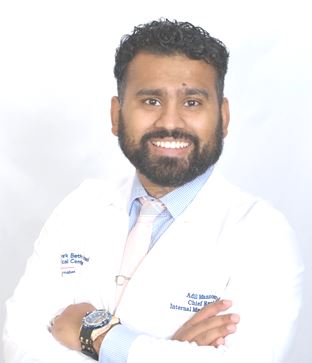
OP / ED BY DR. ADIL MANZOOR
Beyond the age of 65, the risk of many health conditions developing that will make normal living even more difficult arises. Seriously, have you ever lived with an 80-year-old? They require help with a lot of everyday life activities. And that’s just on biology. As we age, the body’s cells, tissues, and organs start to deteriorate, impacting overall health.
There have been several insights into how humans can stay healthy as they age, and one thing that keeps popping up is building muscles and exercise. Yes, you heard me right, despite how counterintuitive or ridiculous it may sound. Consider it, many older adults can barely get a shower unassisted, so how would muscle-building activities be possible or even helpful? Well, in several ways, which I will briefly consider.
Living a normal life and being able to perform everyday activities hinges on certain physical attributes, namely cardiorespiratory fitness, flexibility, dynamic balance, and of course, how strong the muscles are.
Let’s start with flexibility, dynamic balance, and muscle strength. They, as you may already imagine, help with maintaining balance and maneuvering complicated movements. Unfortunately, as we age, there is an involuntary loss of the strength, mass, and effective, function of the muscles. This is known as sarcopenia.
After your 30th birthday, your muscle mass will reduce by 3 to 8% every ten years. What’s more, this decline gets faster the older we get, especially beyond 60 years. The decline also accelerates with a sedentary or physically inactive lifestyle.
Another important physical attribute that determines health as we age is cardiovascular fitness (CRF). This is simply a measure of how effectively the body takes in oxygen and distributes it to muscles and organs during lengthened physical exertion. However, as we age, the heart and its vessels are less effective at circulating blood effectively around the body. As with sarcopenia, while CRF decreases as we age, it gets even worse beyond the age of 70.
When you consider the weakened muscle and the fact that there is less oxygen and nutrients available to this muscle during physical exercise, it makes sense why older adults absolutely detest exercise. Nonetheless, building muscle mass has been found to improve health.
There is a saying popular in the medical world – use it or lose it. This is true with muscle mass, as well. The thing is, you are always going to lose muscle mass as you age, but the rate and extent of muscle loss will be even higher if you don’t actively build muscle mass as you age.
Fortunately, many adults know this and make an attempt to be physically active by doing routine activities like walking. Unfortunately, though, walking alone will not significantly build muscle. The CDC recommends a minimum of “150 minutes a week of moderate-intensity aerobic activity or 75 minutes a week of vigorous-intensity activity or an equivalent combination for more health benefits.” So walking here and there is not sufficient.
Then, aside from walking, it is essential to partake in activities that make the muscles stronger, and this includes weightlifting or the use of resistance bands. This should be done multiple times, at least twice a week. It is advisable to start with small weights before progressing to heavier weights. The transition from the smaller to the larger weights should be gentle and smooth to not increase the risk of injury.
To gain even more from these physical activities, practices that improve flexibility and dynamic balance should be encouraged among older adults. Popular examples of such balance activities include yoga and tai chi.
If there are other conditions, like diabetes and hypertension, the decline in muscle mass may be much faster. Also, this may make it more difficult to exercise and lift weights. As such, these pre-existing conditions must be well-managed in addition to other muscle-building activities. Stay safe.
This article was written by Dr. Adil Manzoor, DO, a Board-Certified Internist & Board Certified Pediatrician who works as a Hospitalist and Emergency Room Physician. He is also the current President of Garden State Street Medicine, a non-profit organization whose sole purpose is to provide free preventive and acute urgent care services for the homeless. He is also the co-founder of his own unique medical practice, Mobile Medicine NJ & House call Doctors. He is also currently pursuing an Executive MBA and a Master’s of Science in Healthcare Leadership at Samuel Curtis Johnson Graduate School of Management and the Weill Cornell Graduate School of Medical Sciences.
References
- https://www.washingtonpost.com/wellness/2023/02/20/aging-weight-training-health/
- https://www.cdc.gov/physicalactivity/basics/adults/index.htm
- https://www.ncbi.nlm.nih.gov/pmc/articles/PMC2804956/